




The best job boards for entry-level jobs, ranked by remote roles

Entry-level remote jobs get the biggest applicant piles on any board, because everyone with a laptop can apply and nobody is filtered out by location. Then many of the listings marked "entry level" ask for three years of experience, and the fake postings that do exist are aimed at beginners most of all, because someone looking for a first job is the least likely to know what a real offer looks like. It is not you. Searching for a first remote job is harder than searching for a fifth.
If you are a student or graduated in the last couple of years, start with the early-career boards (Handshake, RippleMatch, WayUp), where everyone posting expects a short resume. If you are changing careers or coming back after a break, start with the boards whose count is highest and read the requirements line before anything else. Either way, apply in the first two days; entry-level roles often close once enough applications are in, not on a date.
In short
- Largest live list: Remote Rocketship with 21,116 entry-level remote roles. 10,420 of them are open to US residents.
- No paid plan of any kind for job seekers: Indeed, Handshake, RippleMatch, WayUp, Rat Race Rebellion, Glassdoor, ZipRecruiter. Every other board on this page sells something, from a job-seeker subscription to an upgrade.
- If you are a student or graduated in the last year or two, start with Handshake and RippleMatch, where everyone posting expects a short resume, and add LinkedIn for the alumni search and referrals.
The list at a glance
| # | Board | Entry-level remote roles now | Cost to you | Where you apply |
|---|---|---|---|---|
| 1 |  Remote Rocketship | 21,1163,487 new this week10,420 open to US residents | Paid membership for the full list and daily alerts, like most of the big remote boards now. The first results are free to browse. Cancel any time. | On the employer's own site. |
| 2 |  LinkedIn | not published | Free. Premium is optional. | Easy Apply on LinkedIn, or the employer's site. |
| 3 |  Indeed | not published | Free. | On Indeed for many listings, otherwise the employer's site. |
| 4 |  Handshake | not published | Free for students and alumni of partner schools. | On Handshake or the employer's site. |
| 5 |  RippleMatch | not published | Free. | RippleMatch forwards your profile. |
| 6 |  WayUp | not published | Free. | On WayUp. |
| 7 |  FlexJobs | not published | Paid subscription: $2.95 for the first 14 days, then $23.95 every four weeks, or $29.85 for three months or $71.40 a year. | On the employer's site for most jobs; some employers take applications through FlexJobs. A subscription is needed to see the employer name and apply. |
| 8 |  Rat Race Rebellion | not published | Free. | On the employer's own site. |
| 9 |  Glassdoor | not published | Free; an account is asked for to read reviews and salaries. | Easy Apply through Indeed on some listings, the employer's site on the rest. |
| 10 |  ZipRecruiter | not published | Free. | On ZipRecruiter for most listings. |
| 11 |  We Work Remotely | not published | Free to browse. An account is needed to see full job details and apply, and unlimited applications are part of WWR Pro at $14.95 a month on a 12-month commitment. Boosted jobs can be applied to without a subscription. | On the employer's own site. |
How this list was made
The boards here are the ones named most often when students, recent graduates and career changers ask where to look for a first remote job, in career-centre guides, in Reddit threads, and in what ChatGPT and Perplexity answer today, plus the general boards with an entry-level filter and the hand-picked work-from-home lists.
The order is the live count of entry-level remote roles each board publishes, read by a script from its public API, RSS feed or the number printed on its own pages, and refreshed monthly. Where a board does not publish a count we write "not published" and place it after the boards that do, in the order we would check them ourselves. Most boards on this page do not publish one, because entry level is a filter on them rather than a category. Our own count comes from the same search as our category page for this role, run across the whole remote list, with the share open to US residents shown alongside it.
Facts about each board (who posts, what it costs, where you apply) were checked on the board's own site on the date above. Who a board suits is our judgement, and we say when another board is the better pick.
 1. Remote Rocketship
Our own board: remote jobs collected several times a day from the career pages of 100,000+ companies, about a third of them not on LinkedIn, with daily email alerts and a resume match score on every job.
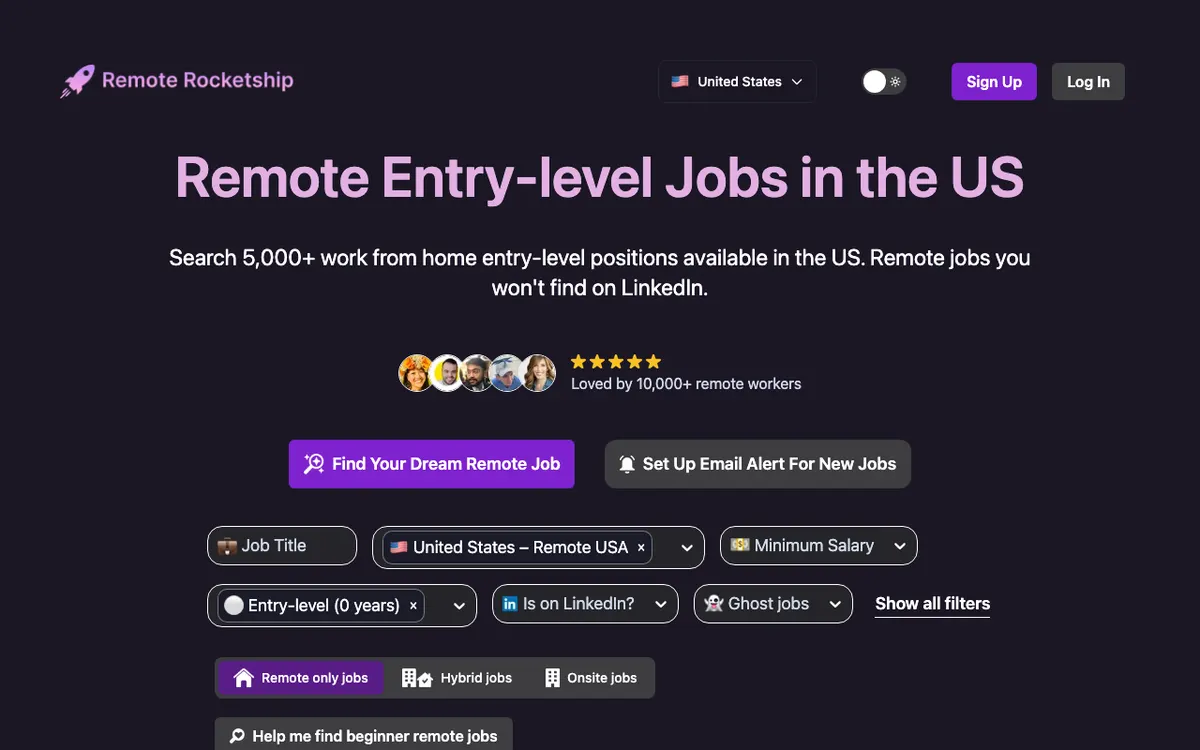
Best for: Career changers and recent graduates who are tired of applying and never hearing back: this is the board that gets you to a job in its first hours, before it reaches LinkedIn, including the roles that never get posted there at all.
Not for: Anyone who will not pay for a job board, or who is still a student and wants internships; Handshake and WayUp are built for that.
- Entry-level remote roles now
- 21,116 entry-level remote roles. 3,487 new this week. 10,420 entry-level remote roles open to US residents.
- Where listings come from
- Collected from company career pages several times a day, not from other boards. Closed listings are removed when the career page drops them.
- Cost to you
- Paid membership for the full list and daily alerts, like most of the big remote boards now. The first results are free to browse. Cancel any time.
- What employers pay to post
- Nothing. Jobs are collected from career pages; employers cannot buy a listing.
- Where you apply
- On the employer's own site.
- Remote filter
- Remote only, with location and US state filters.
What you get
- Every listing is checked several times a day against the company career page and removed the day the company closes it, so there are no ghost jobs.
- Filters by country and US state, salary, seniority, visa sponsorship, tech stack and company size.
- A daily email of new matches, with a resume match score on every job once you upload a resume.
- A "posted on LinkedIn" marker on each job, so you can see which roles have not reached the crowd yet.
Our list of entry-level remote jobs comes straight from the career pages of 100,000+ companies, checked several times a day. About a third of these jobs are not on LinkedIn at all, new ones appear minutes after the company posts them, and closed ones leave the same day, so you see the openings other boards never had and you apply before the pile builds.
- Jobs that are not on LinkedIn. About a third of the roles on Remote Rocketship are not posted on LinkedIn at all, and every job is marked, so you can see which ones the crowd has not found yet.
- Found minutes after they are posted. We check the career pages of 100,000+ companies several times a day, so a new remote role shows up here before it reaches the big boards and you apply before the pile builds.
- Nothing stale. The same checks catch a job the moment a company closes it, so a role that is gone from the career page is gone from here, and roles that sit open for months are flagged as ghost jobs.
- More jobs than any other board on this page: 21,116 entry-level remote roles, by the boards' own numbers, so you are not missing the openings the other boards never saw.
Put together, that is more interviews from the same number of applications: the right jobs, earlier, with fewer people in line.
 2. LinkedIn
The largest professional network, with a job search attached. Most companies post here, so most competition is here too.
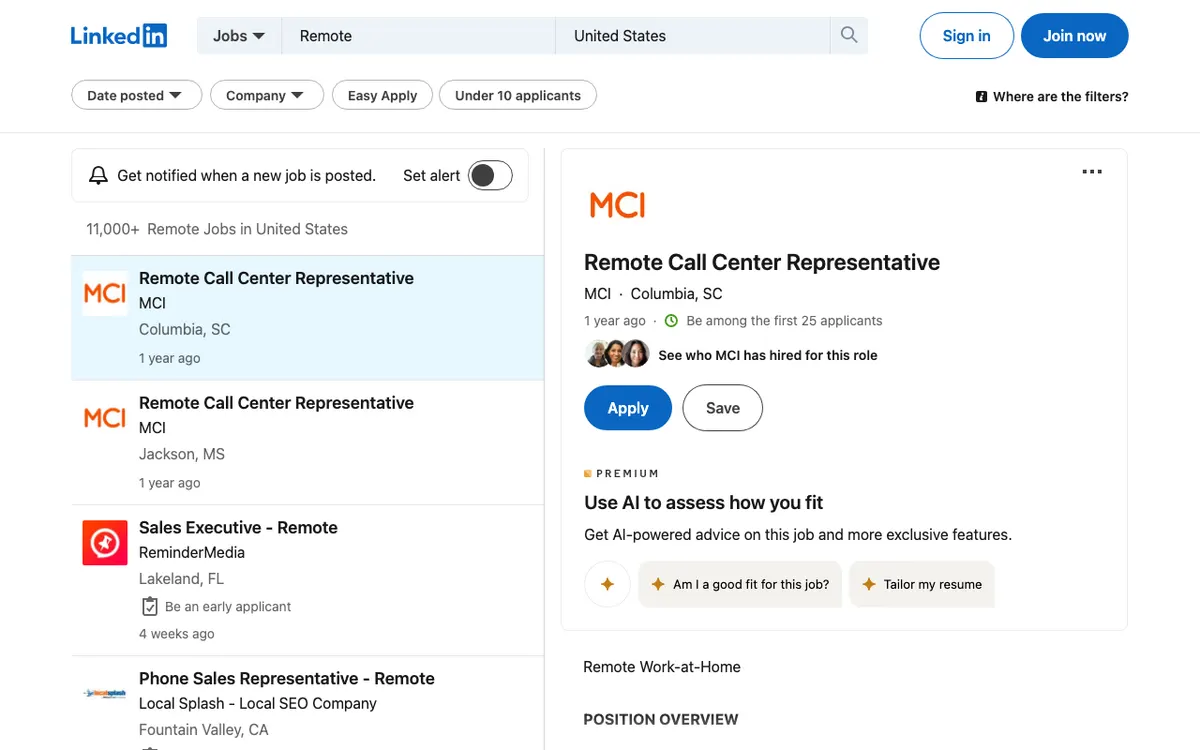
Best for: Finding alumni who can refer you, and seeing the whole market.
Not for: Anyone who finds the applicant counts demoralising, or who takes the experience-level filter at face value.
- Entry-level remote roles now
- Not published
- Where listings come from
- Employers post directly (free and paid posts). Some listings arrive automatically from applicant tracking systems.
- Cost to you
- Free. Premium is optional.
- What employers pay to post
- One free post at a time; promoted posts pay per click.
- Where you apply
- Easy Apply on LinkedIn, or the employer's site.
- Remote filter
- Workplace-type and location filters, though hybrid and on-site roles are often labelled remote.
What you get
- Workplace filter (remote, hybrid, on-site), Easy Apply, and saved searches with email alerts.
- An applicant count on each listing, so you can see the pile before you join it.
- Your network attached to the search: who you know at the company, and recruiters who find you.
- Premium adds how you compare with other applicants and who viewed your profile.
The most entry-level remote listings of any general site, and the biggest piles: an entry-level remote posting here can pass a few hundred applicants in a day, and the experience-level filter is set by the employer, so plenty of "entry level" roles ask for three years. The alumni search is the part worth your time: find people from your school at the company and ask for a referral.
 3. Indeed
The biggest general job search engine. Everything is here, including the roles filled weeks ago.
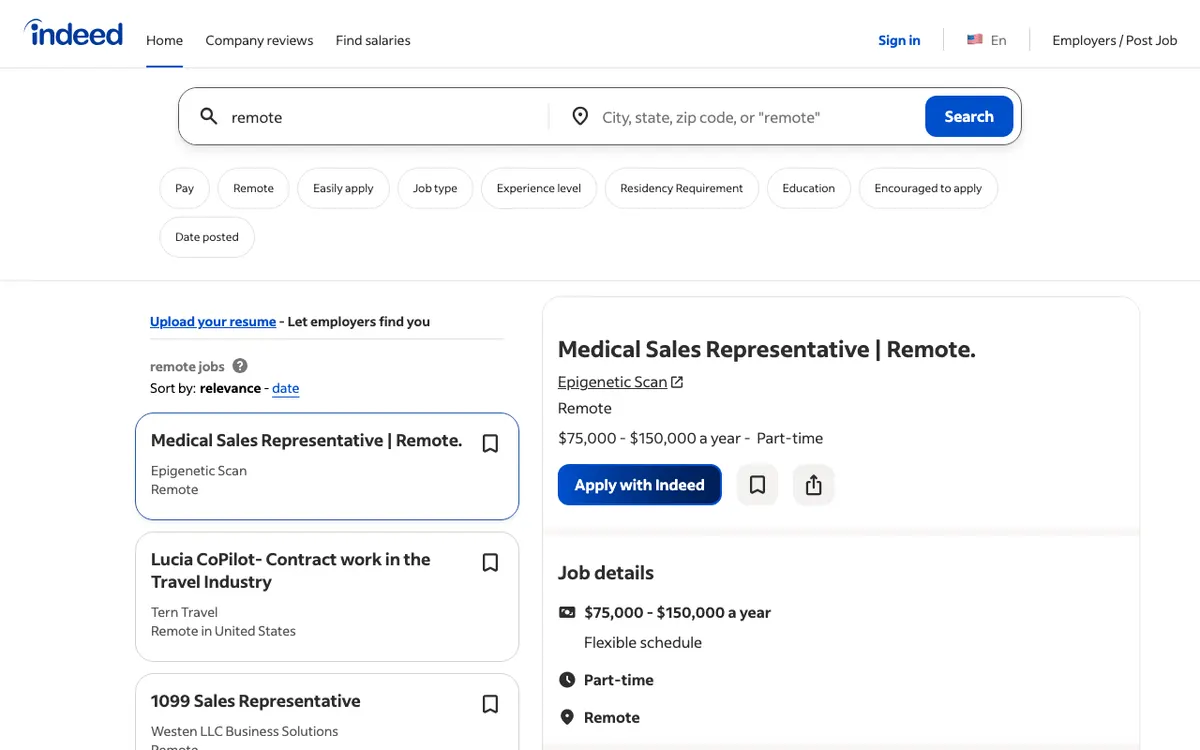
Best for: Entry-level roles outside tech: customer service, healthcare admin, data entry, scheduling, claims.
Not for: Anyone who wants a curated list or a short one.
- Entry-level remote roles now
- Not published
- Where listings come from
- Employers post directly, plus listings Indeed collects from company career sites.
- Cost to you
- Free.
- What employers pay to post
- Free to post, up to three free posts a month; sponsored posts are billed on clicks or started applications.
- Where you apply
- On Indeed for many listings, otherwise the employer's site.
- Remote filter
- Type Remote in the location box. Many results are hybrid.
What you get
- Email alerts, plus Indeed's own company reviews and salary pages.
- Indeed Apply on many roles, with a stored resume.
- Filters for remote, salary, job type and date posted; the date filter is the one that matters here.
Everything is here, including entry-level roles at small companies, hospitals and call centres that post nowhere else, and including roles filled weeks ago. Type Remote in the location box, use the experience-level filter, set the date to the last few days, and read the requirements line before the title.
 4. Handshake
The early-career network used by 1,600+ colleges and universities for internships and first jobs.
Best for: Current students and graduates of partner schools looking for a first job or an internship, remote included.
Not for: Anyone whose school is not on Handshake, or who graduated more than a few years ago.
- Entry-level remote roles now
- Not published
- Where listings come from
- Employers post for students and recent graduates of partner schools.
- Cost to you
- Free for students and alumni of partner schools.
- What employers pay to post
- Free to post, with paid plans for larger programmes.
- Where you apply
- On Handshake or the employer's site.
- Remote filter
- Remote filter.
What you get
- Employers expecting a short resume; the network is built for students, graduates and people restarting a career.
- Virtual career fairs and events run with your school.
The early-career network 1,600+ colleges and universities use, so every employer here expects a student or a recent graduate and nobody is surprised by a short resume. Employers have to be approved by your school before they can post to its students, which is the closest thing to a screened list a beginner gets for free.
 5. RippleMatch
An early-career matching service: you build a profile and it sends you to roles that fit.
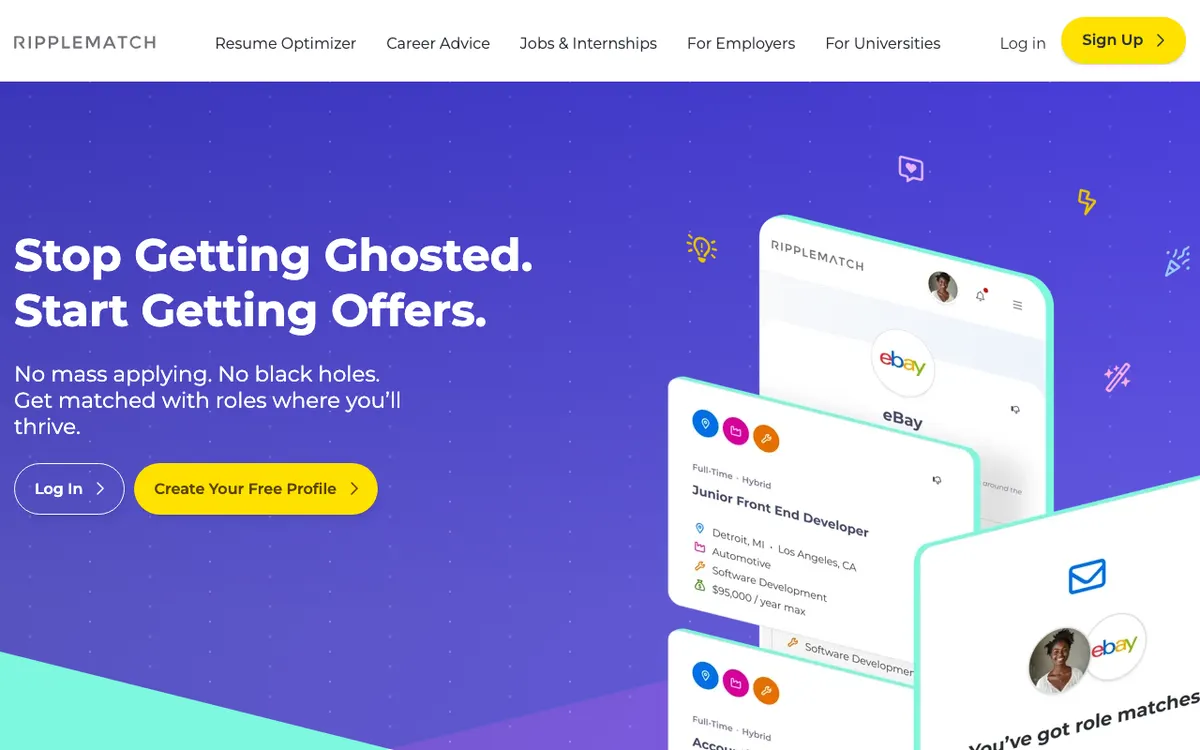
Best for: Graduating students and recent graduates who want to be matched rather than search, especially for roles at large companies.
Not for: Career changers, anyone more than a few years out of school, or anyone who wants a full searchable board; the Discover lists are short.
- Entry-level remote roles now
- Not published
- Where listings come from
- Employers hire through RippleMatch for early-career roles.
- Cost to you
- Free.
- Where you apply
- RippleMatch forwards your profile.
- Remote filter
- Roles are tagged remote, hybrid or in person; your preferences live in your profile.
What you get
- One profile, then matches sent to you; a Discover Jobs directory exists but matching is the main route.
- Interview preparation tools for first-time applicants.
You build one profile and RippleMatch sends it to the early-career roles that fit, so you apply once rather than fifty times. The employers are mostly larger companies hiring graduate classes, and remote roles are tagged in the Discover lists and in your matches.
 6. WayUp
Internships and entry-level jobs for students and recent graduates.
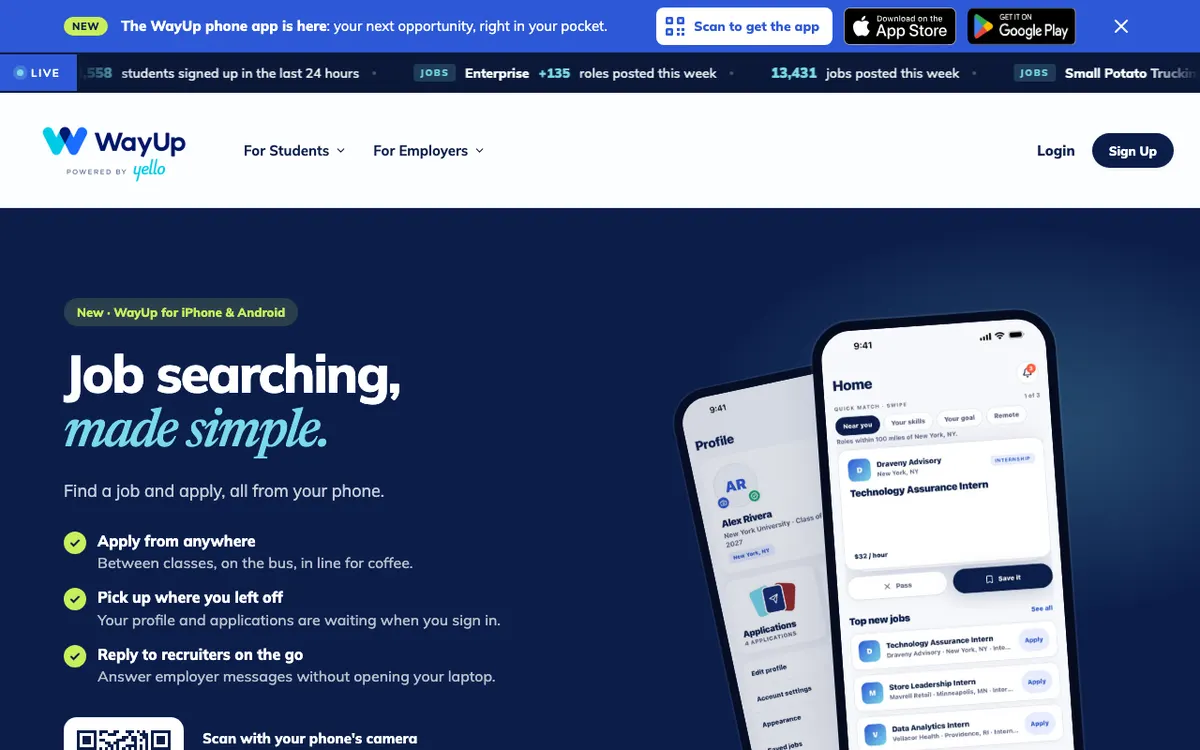
Best for: Students and recent graduates whose school is not on Handshake, and anyone looking for a remote internship.
Not for: Career changers and anyone past their first couple of years of work.
- Entry-level remote roles now
- Not published
- Where listings come from
- Employers post.
- Cost to you
- Free.
- Where you apply
- On WayUp.
- Remote filter
- Location filters; remote roles are tagged in the listing.
What you get
- Internships and entry-level jobs, from large employers' early-career programmes to hourly and driving work.
- Profile-based matching and employer events.
Internships and entry-level jobs for students and recent graduates, with tagged remote roles and employer pages written for people who have not had a job before. Smaller than Handshake and open to anyone, with no school account needed.
 7. FlexJobs
A subscription board for remote, hybrid and flexible jobs, with each listing screened by its research team.
Best for: Beginners who want someone else to screen out the junk, and entry-level roles outside tech.
Not for: Anyone who expects listings nobody else has; most can be found free elsewhere with more effort.
- Entry-level remote roles now
- Not published
- Where listings come from
- Hand-screened by FlexJobs staff from employer sites and postings.
- Cost to you
- Paid subscription: $2.95 for the first 14 days, then $23.95 every four weeks, or $29.85 for three months or $71.40 a year.
- Where you apply
- On the employer's site for most jobs; some employers take applications through FlexJobs. A subscription is needed to see the employer name and apply.
- Remote filter
- Remote, hybrid and flexible filters, plus location.
What you get
- Every listing screened by staff, with scams and commission-only "jobs" kept out.
- Filters for remote level (fully remote, hybrid), schedule (full-time, part-time, freelance) and career level.
- Career webinars and events, guides and video courses for members, plus an auto-apply tool (ExpertApply).
Every listing is screened by a research team before it goes up, which is worth more at entry level than anywhere else, because beginners are the people fake postings are written for. The entry-level section is wide, with customer service, admin, data entry and writing roles that tech boards never carry. You pay for the screening.
 8. Rat Race Rebellion
A daily, hand-picked list of work-from-home jobs, heavy on customer service and hourly roles.
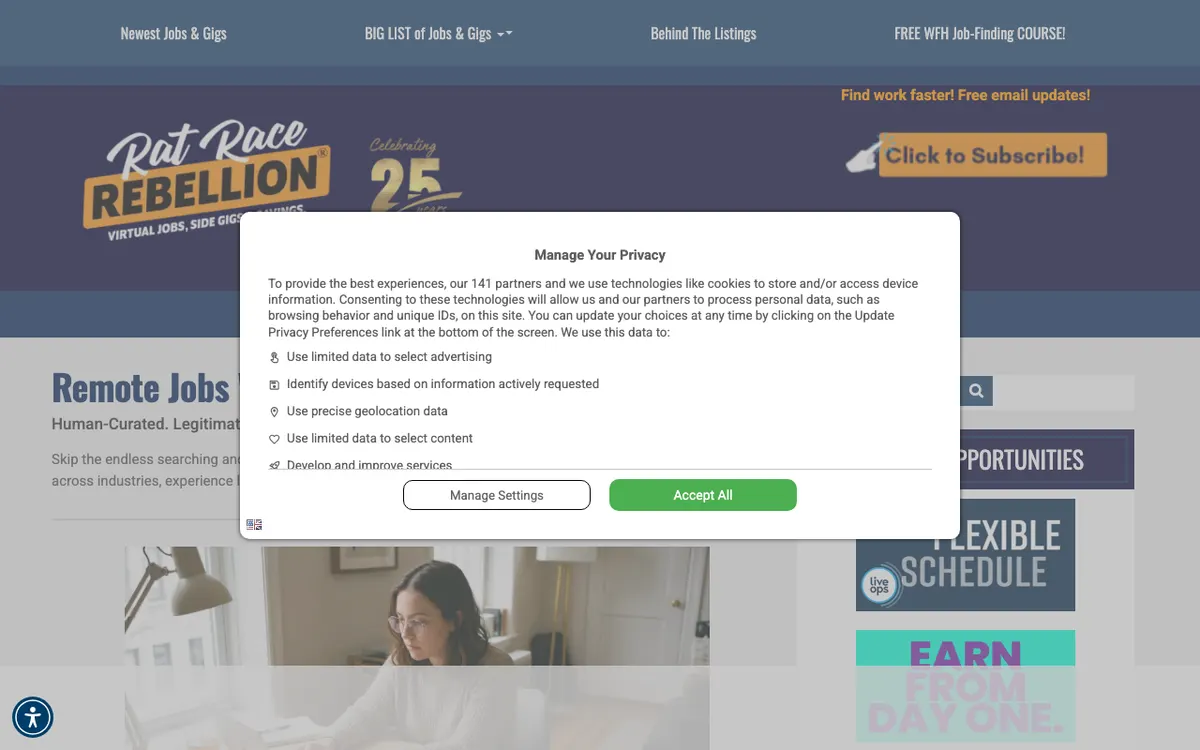
Best for: Customer service, data entry and other hourly work-from-home roles that need no degree.
Not for: Anyone looking for a salaried professional role or a tech job; the list is short and mostly hourly.
- Entry-level remote roles now
- Not published
- Where listings come from
- Human-reviewed leads taken from official employer career pages, published daily.
- Cost to you
- Free.
- What employers pay to post
- Nothing to submit a posting for review; sponsored jobs start at $400 a week, and the site says some daily-post links are paid or affiliate links.
- Where you apply
- On the employer's own site.
- Remote filter
- Work from home only.
What you get
- A daily list of work-from-home jobs with the hourly rate in the headline, each linked to the employer's own page.
- Non-phone and part-time roles called out in the headline, and every lead reviewed before it is published.
A daily, hand-picked list of work-from-home jobs, heavy on customer service, data entry and hourly roles, with each listing reviewed by its staff before it goes up. The list is short, free, and pitched at exactly the roles most first-time remote workers actually get.
 9. Glassdoor
Company reviews and salaries with a job search attached. It shares listings with Indeed.
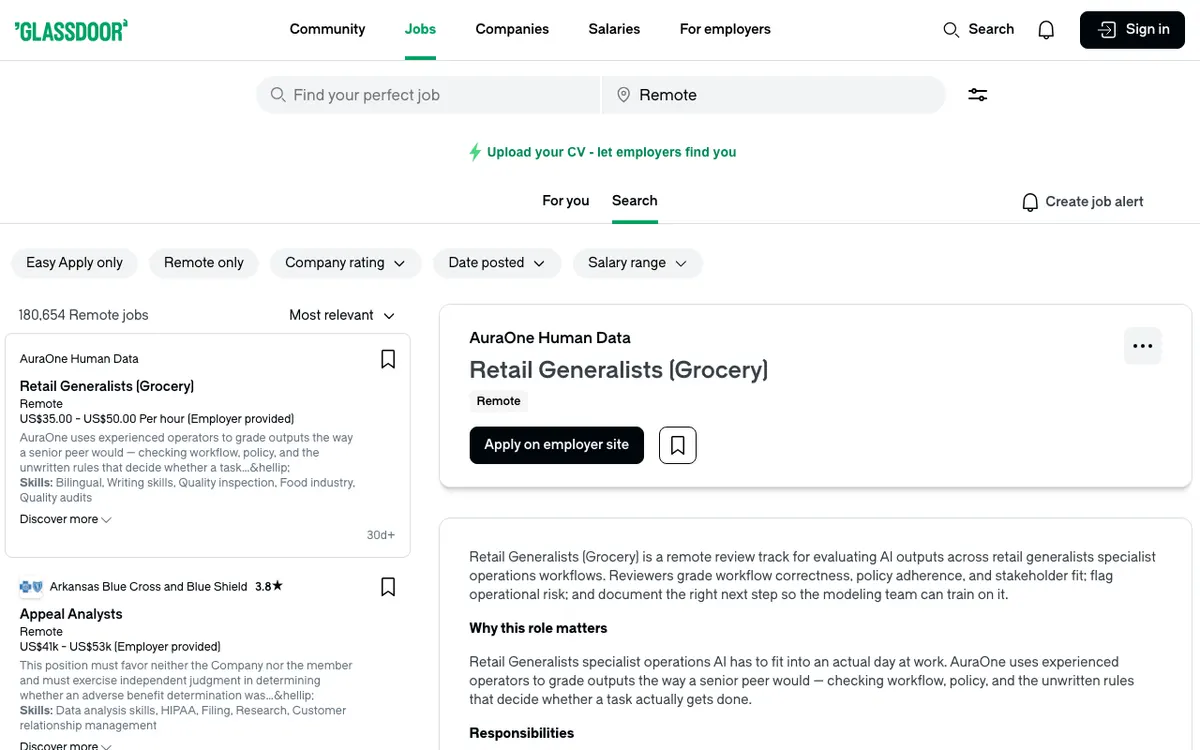
Best for: Checking a company before you apply, and finding out what an entry-level role actually pays.
Not for: Searching itself; the listings are the same as Indeed's, so pick one.
- Entry-level remote roles now
- Not published
- Where listings come from
- Listings come from Indeed, which now owns Glassdoor; employers post through Indeed.
- Cost to you
- Free; an account is asked for to read reviews and salaries.
- Where you apply
- Easy Apply through Indeed on some listings, the employer's site on the rest.
- Remote filter
- Remote and location filters.
What you get
- Employee reviews, salaries and interview questions next to each company's jobs.
- The same listings as Indeed, with the remote filter.
Company reviews and salary reports with a job search attached, sharing listings with Indeed. For a first job the reviews matter more than the search: before you spend an hour on an application, five minutes of reading what current employees say tells you whether the company is real, how it treats new hires and what the role actually pays.
 10. ZipRecruiter
A general board that matches your profile to postings and sends them to you.
Best for: Volume applications to entry-level roles outside tech, and people who want postings pushed to them.
Not for: Anyone who wants to stand out; the easier the apply button, the bigger the pile.
- Entry-level remote roles now
- Not published
- Where listings come from
- Employers post.
- Cost to you
- Free.
- Where you apply
- On ZipRecruiter for most listings.
- Remote filter
- Workplace and location filters.
What you get
- Matching that sends roles to you, with an apply form on ZipRecruiter.
- Email alerts and a workplace filter.
A general board that matches your profile to postings and sends them to you, with a short apply form on most listings. For entry-level roles that is both the appeal and the trap: it is easy to apply to forty jobs in an evening, and most of the other applicants did the same.
 11. We Work Remotely
One of the oldest remote-only boards, organised by category, with a small number of listings at any time.
Best for: A small, clean list at companies that are remote by design, for beginners in tech, design, support or marketing.
Not for: Anyone who needs volume, or who is looking for hourly and customer service work.
- Entry-level remote roles now
- Not published
- Where listings come from
- Employers pay to post, directly or through an ATS integration. WWR does not collect listings from other boards.
- Cost to you
- Free to browse. An account is needed to see full job details and apply, and unlimited applications are part of WWR Pro at $14.95 a month on a 12-month commitment. Boosted jobs can be applied to without a subscription.
- What employers pay to post
- $299 per post for 30 days.
- Where you apply
- On the employer's own site.
- Remote filter
- Remote only, with region restrictions shown on each listing.
What you get
- Categories for programming, design, customer support, sales and marketing, product, and management and finance, each with its own RSS feed.
- The region each role is open to (anywhere, USA only, Europe only) shown on the listing.
- A $299 posting fee, which keeps the list short and mostly current.
Employers pay to post, so almost every listing is a company spending money to hire, which counts for a lot when you cannot yet tell a good posting from a bad one. Junior roles are a small share of a small list, so treat it as a weekly check rather than a daily one.
Which one should you use?
If you are a student or graduated in the last year or two, start with Handshake and RippleMatch, where everyone posting expects a short resume, and add LinkedIn for the alumni search and referrals. If you are changing careers or coming back after a break, start with a board that updates several times a day and filters to remote (ours), or Indeed with the experience-level and date filters set), and add FlexJobs or Rat Race Rebellion if you want the list screened and your target is customer service, admin or hourly work.
Whichever two you pick, check them daily and apply in the first two days. Entry-level remote roles close on volume, not on a date, and the people who get interviews are the ones who were early, not the ones who searched the most sites. And read the requirements before the title, every time.
Questions people ask
Where can I find entry-level remote jobs?
Start with Remote Rocketship if you want entry-level remote jobs minutes after they are posted on the company's own site: we check 100,000+ career pages several times a day, and about a third of the roles are not on LinkedIn at all. LinkedIn and Indeed have the most listings overall, each with an experience-level filter; Handshake, RippleMatch and WayUp are built for students and recent graduates; FlexJobs and Rat Race Rebellion screen their lists, which matters most when you are starting out. Our figure is our whole remote list for this role family; about 9,800 of those are open to US residents.
Which job board has the most entry-level remote jobs?
By the counts each board publishes on the date above, Remote Rocketship, with over 21,000 entry-level remote roles, more than any other board on this page that publishes a count. About 10,000 of those are open to US residents, every one comes from a company career page, and about a third are not on LinkedIn at all. LinkedIn and Indeed almost certainly list more, hybrid included, but publish no count a script can read.
Why do entry-level remote jobs ask for three years of experience?
Because "entry level" on most boards is a box the employer ticks, not a check anyone runs, and some employers use it to mean the lowest rung on their own ladder rather than a first job. Read the requirements line, apply anyway if you meet most of it, and spend your early effort on the postings that say zero to two years.
How do I avoid scams when looking for entry-level remote jobs?
Apply on the company's own career page where you can, never pay for equipment, training or a background check, and be wary of offers made over text or chat without a video interview. Boards that screen listings (FlexJobs, Rat Race Rebellion, and Handshake, where your school approves the employers) cut the risk, and so does a board that only lists what is on a company's own site.
Why is Remote Rocketship on its own list?
Because it belongs there, and leaving it off would be the less honest choice. It is placed by the same count as every other board, gets the same facts and the same "not for" line, and the counts come from a script, not from us. What it brings to this list: jobs found minutes after they are posted on the company's own site, about a third of them not on LinkedIn at all, checked several times a day so nothing is stale. Links to the other boards are plain links; nobody pays to be here.
Did we miss something? Tell us at [email protected].
Apply before the competition even sees the job
About a third of the jobs on Remote Rocketship are not on LinkedIn at all. We check the career pages of 100,000+ companies several times a day, so new remote roles show up here minutes after they are posted and closed ones disappear the same day. More jobs, earlier, with fewer people in line: that is how members get more interviews from the same applications. See the entry-level remote jobs now.
Show me the entry-level remote jobsWritten by Lior Neu-ner, Founder, Remote Rocketship. Remote Rocketship is a paid job board and appears in these lists; it is placed by the same measure as everyone else and never first by default. Links to other boards are plain links; nobody pays to be listed.


